RFID in the Academic Library: Self-Checkout, Security, and the One-Card Link
The same student credential that opens a residence hall also borrows a book in seconds. Here is how 13.56 MHz RFID powers self-checkout, anti-theft gates, and real-time inventory in the modern university library — and why the smartest deployments tie circulation straight to the campus card.
How this guide is reviewed
CampusRFID reviews technical guides against standards and official documentation. Where a source list appears, it identifies the primary references used. Card and reader compatibility should still be verified with a sample on the institution's installed system.
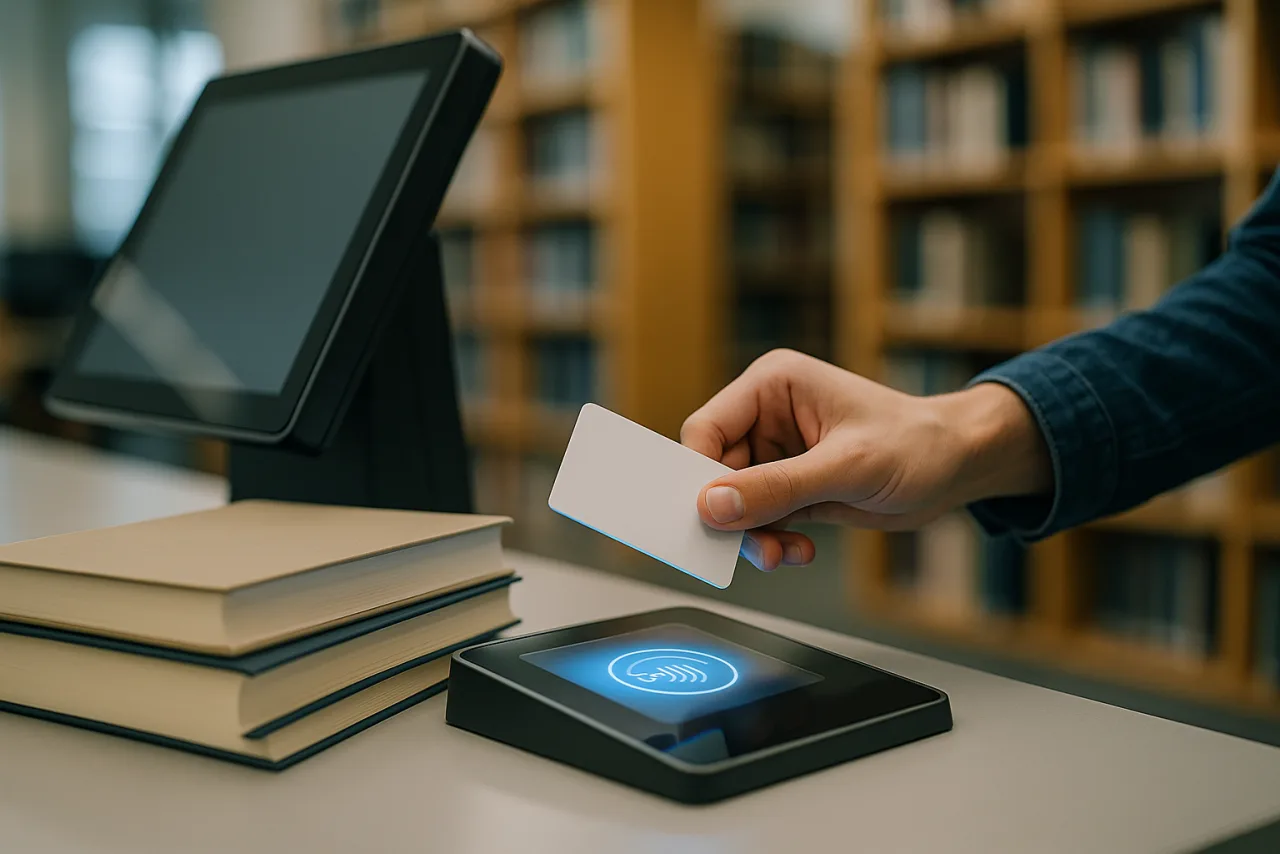
The academic library can be one of the most RFID-intensive environments on a campus. In a library deployment, item tags support circulation, security, and inventory, while the student's campus credential identifies the borrower. Connecting those two systems at the integrated library system (ILS) can simplify the experience, but the item tags and student credential do not necessarily use the same contactless protocol or reader configuration.
Why Libraries Standardized on 13.56 MHz HF
Library item-level RFID commonly uses high-frequency (HF) 13.56 MHz tags. ISO/IEC 15693 defines the vicinity-card communication used by many library item tags, while the ISO 28560 series defines library data elements and encoding profiles. Contactless campus credentials commonly use ISO/IEC 14443 instead. ISO 28560 improves portability when systems use the same profile, but a migration still requires confirmation that the existing tags, encoding, readers, gates, and ILS connector are compatible.
The two systems can therefore share the 13.56 MHz frequency without being interchangeable. A kiosk may need one reader for ISO 15693 item tags and another credential interface that supports the campus card's protocol and keys. The integration point is the borrower account in the ILS, not the radio frequency alone.
Self-Checkout: From Bottleneck to Background Task
The most visible payoff is circulation. A traditional barcode checkout requires line-of-sight scanning of one item at a time. RFID self-checkout kiosks read multiple tagged items simultaneously — a student drops a stack of books on the pad, taps their campus card to authenticate against the integrated library system (ILS), and the entire transaction completes in seconds. Returns can be just as fast, with automated return chutes that check items in and re-activate security the moment a book is dropped.
The operational effect is a redistribution of staff time rather than a reduction in service. When routine checkouts move to self-service, librarians spend less time at a transaction desk and more on research support, instruction, and collection work — the activities that actually differentiate an academic library. For students, the win is throughput during the predictable crush of midterms and finals, when the last thing anyone wants is a queue.
Security Gates and Inventory: The Invisible Wins
RFID security gates can use an item's tag status or identifier to flag material that has not been properly checked out. Whether a gate can identify and log a specific title depends on the tag profile, gate configuration, and ILS integration; it should not be assumed from RFID alone.
Inventory is where RFID changes what is operationally possible. Shelf-reading a large academic collection with barcodes is so labor-intensive that many libraries simply never do a full inventory. With a handheld RFID wand, a staff member can sweep a shelf range and capture every item's identifier in a fraction of the time, instantly surfacing misshelved books, items marked missing that are actually present, and gaps in a sequence. What was once a multi-week, all-hands project becomes a routine, repeatable task — which means catalogs stay accurate and students actually find the book the system says is there.
The One-Card Link: Where the Real Value Lives
The strategic opportunity is not RFID in the library as an island — it is connecting library RFID to the institution's broader credential program. When borrowing privileges live on the same card that handles building access, dining, and payments, the student carries one credential for everything and the institution manages one identity.
That unification can pay off in practical ways. A lost credential can be deactivated centrally for linked services, including library borrowing. Enrollment status can flow from the student information system to the ILS so borrowing privileges follow the student's status without manual list maintenance. Institutions can coordinate one identity lifecycle even when the library item-tag infrastructure and campus credential readers remain technically separate.
Mobile credentials can extend the same identity model, but only where the campus platform and the kiosk's credential reader explicitly support the mobile protocol. A phone should not be assumed to work merely because the kiosk accepts a physical contactless card.
A Note on Attendance and Privacy
The same campus credential may be used for library authentication and RFID attendance workflows, although the readers and applications can differ. Whenever borrowing records or entry logs are tied to an identifiable student, those records can fall under privacy obligations — FERPA in the United States and equivalent regimes elsewhere. Libraries have a long professional tradition of minimizing circulation-history retention, and a well-designed RFID program respects that: authenticate at the point of transaction, retain only what policy requires, and keep personal data off item tags.
Planning a Library RFID Deployment
For institutions weighing a project, first choose an ISO 28560 encoding profile and confirm the matching ISO/IEC 15693 item tags, kiosks, gates, handheld readers, and ILS connector. Plan the tagging effort by collection area and test a representative sample before scaling. Then integrate borrower authentication with the existing campus identity where appropriate, using a credential reader that explicitly supports the institution's physical and mobile credentials. Circulation, security, and inventory should share the item-tag profile even if borrower authentication uses a separate interface.
The academic library was an early adopter of RFID for good reason: the technology maps cleanly onto how a library actually works. Tied into a unified campus credential, it stops being a standalone library system and becomes one more service on the card every student already carries.
Ready to extend your campus credential into the library — or build a unified RFID program from the ground up? Contact our team to design a system that connects access, payments, and circulation on a single student card.
Primary sources
Standards, regulations, and first-party technical documentation consulted for this review.
- ISO 28560-1:2023 — RFID in libraries — International Organization for Standardization
- NISO RP-6-2012, RFID in U.S. Libraries — National Information Standards Organization
- RFID in Libraries: Privacy and Confidentiality Guidelines — American Library Association
Explore this topic
Product pages selected for the subject covered in this guide.
Library Cards
RFID cards for automated book checkout, attendance tracking, and resource management across campus libraries.
Student ID Cards
RFID student ID cards specified for campus access, dining, library, payments and attendance workflows, subject to each institution's reader and data requirements.
Ready to Implement RFID on Your Campus?
Contact us to learn how our RFID solutions can improve campus security and student experience.
Related Articles
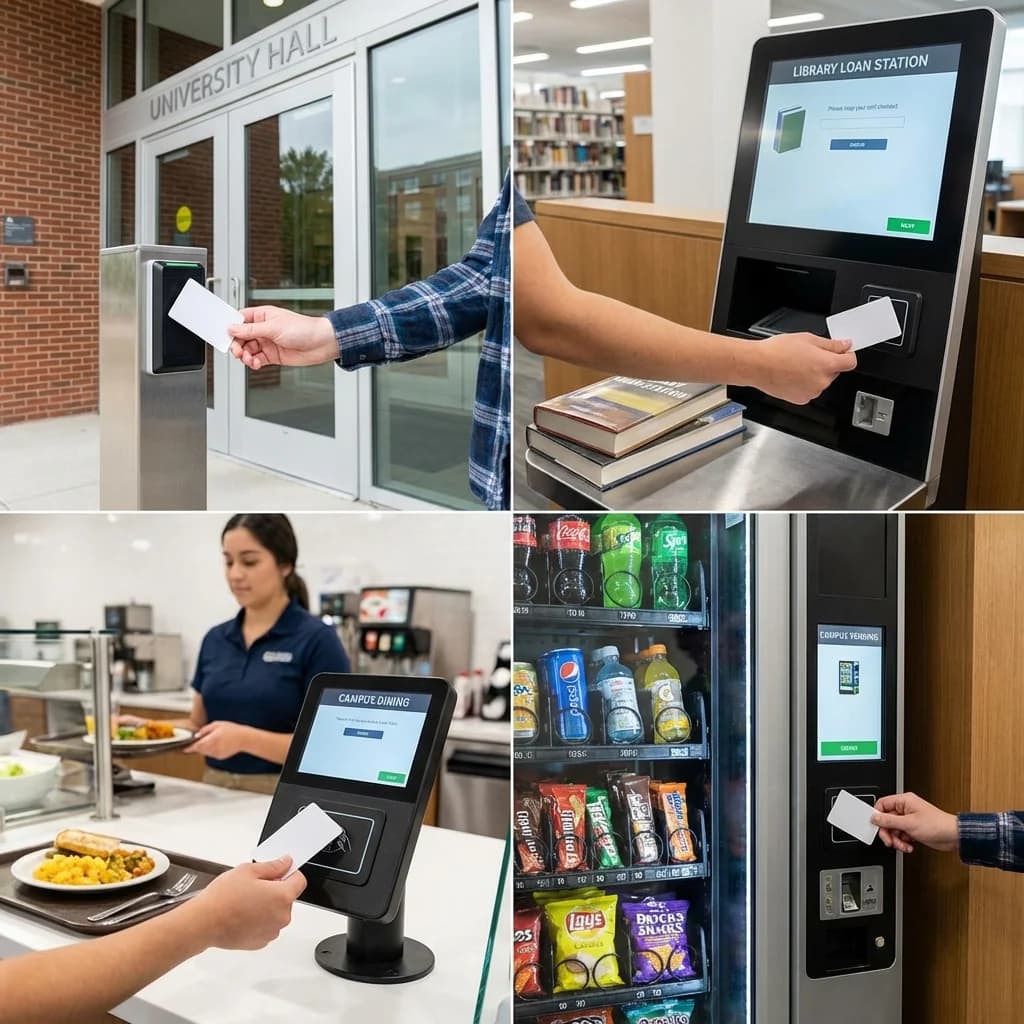
Campus Card Use Cases: Access, Payments, Library & Dining
Every major use case for RFID campus cards — access control, meal plans, library, laundry, printing, parking, transit and events. Infrastructure and ROI.
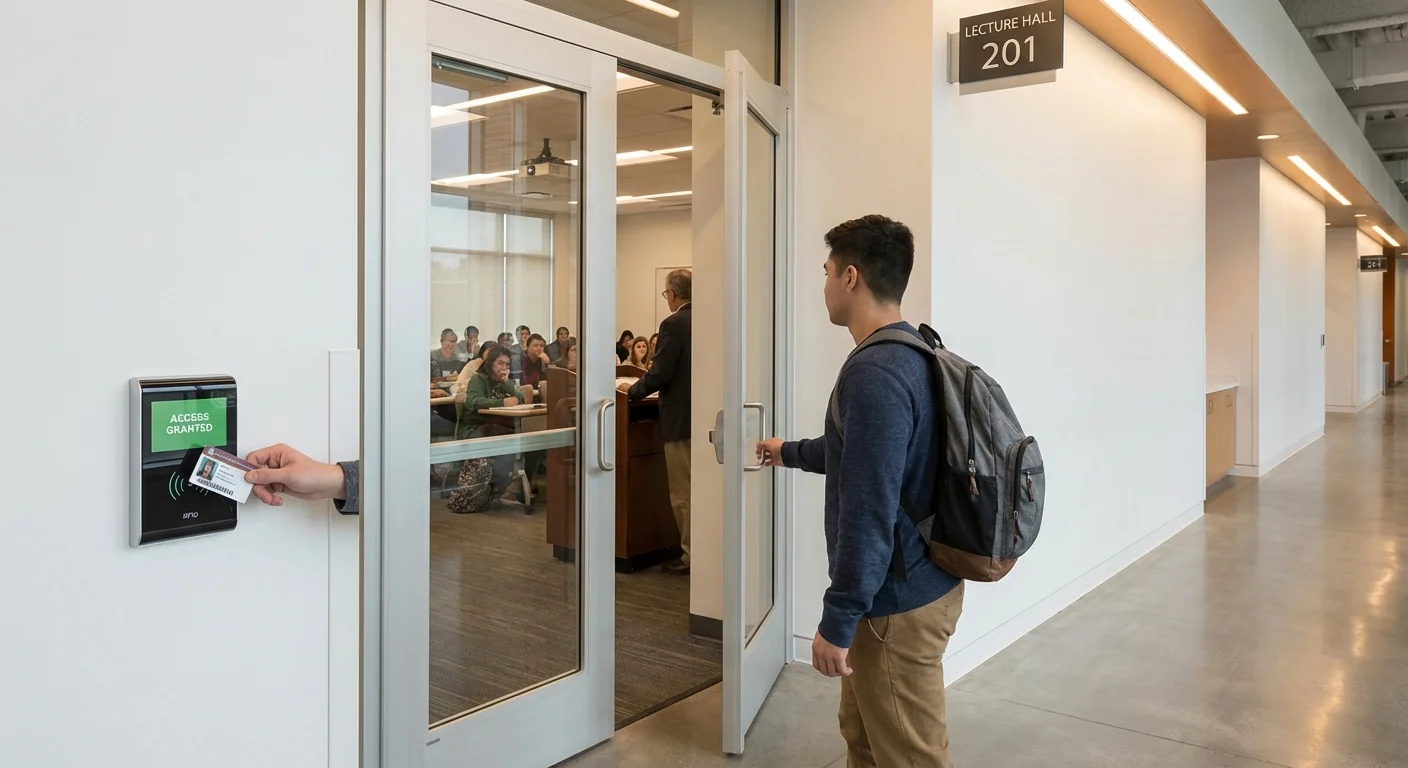
RFID Attendance Tracking for Universities: Complete Implementation Guide
RFID-based attendance tracking eliminates manual roll calls and buddy punching while giving universities real-time insight into lecture attendance patterns. This comprehensive guide covers the technology, integration with learning management systems, and GDPR considerations for European institutions.