Campus Card Security: Encryption, Authentication, and Cloning Prevention
From the broken Crypto-1 cipher on legacy sector-memory 13.56 MHz credential to AES-128 encryption on modern AES-authenticated 13.56 MHz credentials, campus card security has evolved dramatically. This deep dive covers how encryption, mutual authentication, and diversified keys protect your campus — and why legacy systems must be replaced.
How this guide is reviewed
CampusRFID reviews technical guides against standards and official documentation. Where a source list appears, it identifies the primary references used. Card and reader compatibility should still be verified with a sample on the institution's installed system.
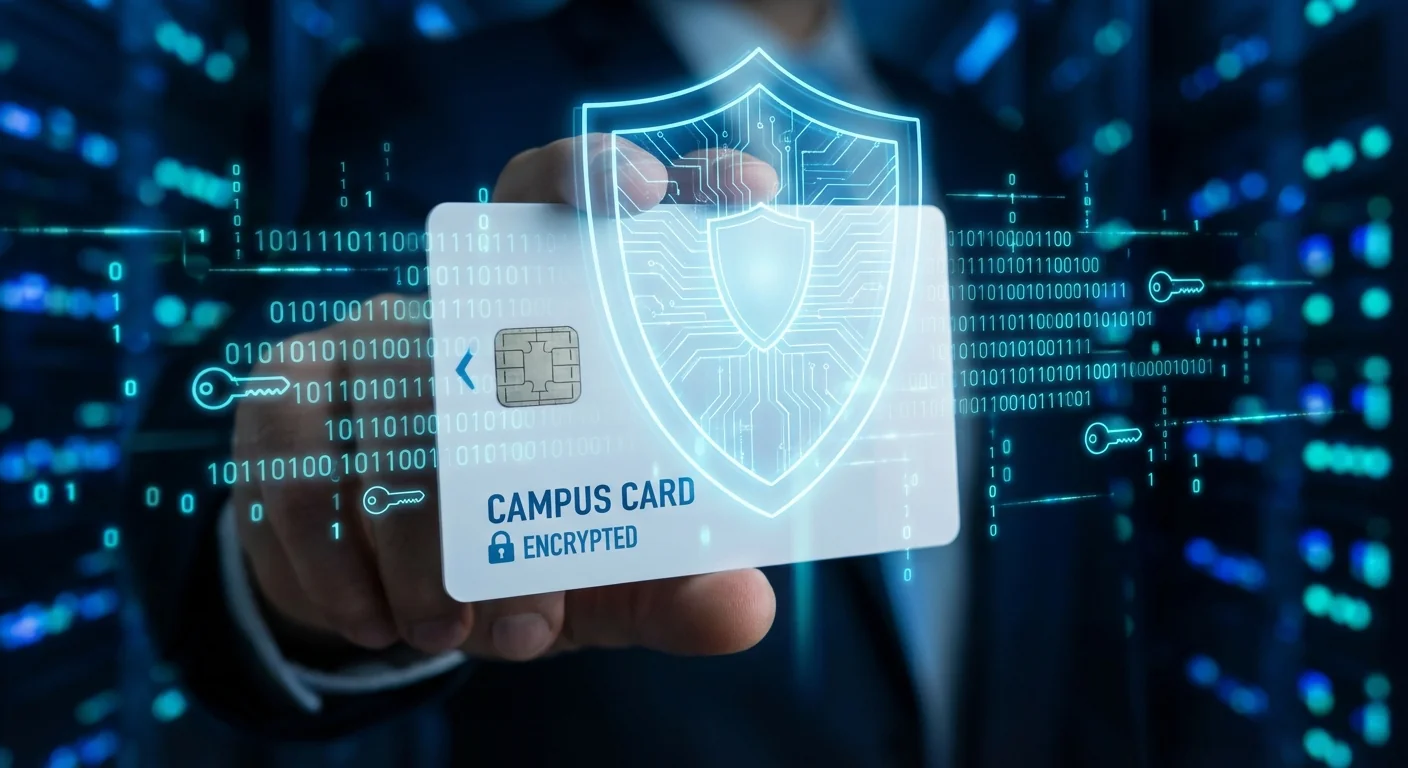
legacy sector-memory 13.56 MHz credential's Crypto-1 cipher has been the subject of published practical attacks since 2008. That history matters because a card that still relies on a static identifier or a compromised legacy cipher should not be presented as a modern secure credential. The appropriate response is a documented migration plan based on the actual reader fleet, credential format, key ownership and risk of each access zone.
Campus card security is not abstract. A compromised card system means unauthorized people in buildings, stolen meal plan balances, fraudulent library loans, manipulated printing credits, and — in worst cases — physical safety risks. Understanding the cryptographic technologies that protect (or fail to protect) campus cards is essential for every university IT and security professional.
The Cryptographic Landscape of Campus Cards
125 kHz Proximity Cards: Zero Security
The oldest technology still found on some campuses is the 125 kHz proximity card, including EM4100 and other legacy formats. In common configurations, these credentials expose a static identifier without cryptographic mutual authentication. Their exact read range and duplication risk depend on the credential and equipment, but they should be treated as legacy identification technology rather than as a high-security control.
If a campus still uses 125 kHz credentials, inventory the doors, reader models, controller path and credential formats first. Prioritize restricted and safety-critical zones, then design a phased replacement that does not assume the card alone determines security.
legacy sector-memory 13.56 MHz credential: Broken Encryption (Crypto-1)
legacy sector-memory 13.56 MHz credentials (operating at 13.56 MHz, ISO 14443A) were a massive improvement over proximity cards when introduced. They use the Crypto-1 stream cipher for authentication between card and reader. Unfortunately, Crypto-1 was reverse-engineered in 2008 by researchers at Radboud University Nijmegen. The attack was subsequently refined to the point where cloning a legacy sector-memory 13.56 MHz credentials takes under a minute with readily available hardware.
Despite this, legacy sector-memory 13.56 MHz credential remains in use at a surprising number of institutions. The cards are cheap, the infrastructure is established, and migration requires effort and budget. But the risk is real and well-documented: anyone with basic technical knowledge and inexpensive equipment can clone these cards.
AES-authenticated 13.56 MHz credential: Modern Security
AES-authenticated 13.56 MHz credential and current AES-authenticated configuration support AES-128 for contactless applications. AES is a standardized block cipher; its presence is not by itself proof that a complete campus deployment is secure. Key generation, diversification, storage, reader authentication, controller communications and backend authorization must also be designed correctly.
Mutual authentication is the critical advancement. When a AES-authenticated 13.56 MHz credentials approaches a reader, both the card and the reader must prove their identity to each other before any data exchange occurs. The card proves it holds the correct cryptographic key, and the reader proves the same. This prevents both card cloning (a fake card can't authenticate) and rogue readers (a fake reader can't extract card data).
Diversified keys add another security layer. Rather than using the same key for every card, the system derives a unique key for each card based on its serial number and a master key. If one card's key is somehow compromised, it cannot be used to attack any other card in the system.
Transaction MAC provides cryptographic proof that a specific transaction occurred between a specific card and a specific reader at a specific time. This is particularly important for cashless payment applications where transaction disputes may arise.
AES-authenticated 13.56 MHz credential's Secure Dynamic Messaging (SDM) enables secure data exchange with NFC smartphones without requiring a dedicated app — supporting use cases like digital identity verification where a student taps their card on a phone to share authenticated credentials.
mobile-ready enterprise credentials: Proprietary Modern Security
Proprietary mobile-ready credential platforms can support modern cryptography, mutual authentication and protected credential objects. The exact algorithms, certification scope, reader support, licensing and key-custody model vary by platform and must be verified for the selected deployment. The trade-off is operational dependence on that ecosystem for readers, provisioning and future migration.
Threats to Include in the Security Review
A useful threat model should cover copied or replayed identifiers, lost credentials, weak shared keys, unauthorized readers, relay attacks, compromised card-office workstations, reader-to-controller interception and excessive backend permissions. The relevance of each threat depends on the installed technology and the consequence of access to a given zone.
AES-authenticated 13.56 MHz credential includes security features that can support stronger designs, but they must be configured and tested within the complete system. Product capabilities should never be converted into a blanket claim that every card or deployment is clone-proof.
Migration Priority Framework
If your university is evaluating card security, here's a priority framework:
Higher Priority — Document and Plan Migration
Review with the Platform Vendor
Modern Options — Validate the Complete Configuration
Practical Security Recommendations
Beyond chip selection, campus card security requires attention to the broader system:
At CampusRFID, we manufacture campus cards using the latest chip technologies — AES-authenticated 13.56 MHz credential, AES-authenticated 13.56 MHz credential, mobile-ready enterprise credentials, and multi-technology combinations for migration scenarios. Every card we produce is programmed with your institution's specific key configuration and security parameters.
*Concerned about your campus card security? Contact our team for a security assessment and migration planning consultation.*
Primary sources
Standards, regulations, and first-party technical documentation consulted for this review.
- FIPS 197 — Advanced Encryption Standard (AES) — National Institute of Standards and Technology
Explore this topic
Product pages selected for the subject covered in this guide.
Ready to Implement RFID on Your Campus?
Contact us to learn how our RFID solutions can improve campus security and student experience.
Related Articles

Campus Card Credential Technologies: A Capability-Based Comparison
A vendor-neutral comparison of 13.56 MHz campus credentials by reader support, authentication, key management, mobile readiness and migration risk
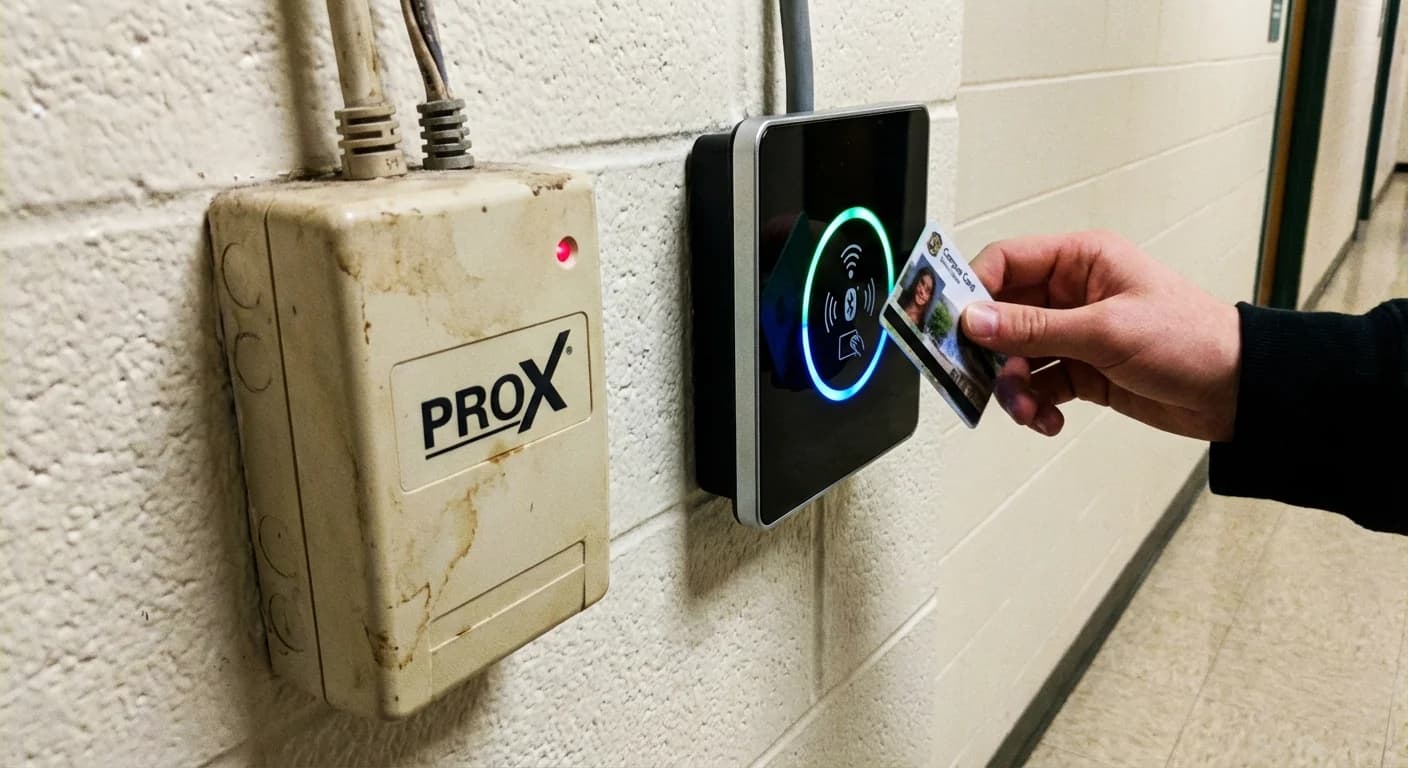
Multi-Technology Campus Cards: Running Legacy and Modern Systems Together
Most universities don't have the luxury of replacing every reader overnight. Multi-technology cards that combine 125 kHz proximity, legacy sector-memory 13.56 MHz credential, AES-authenticated 13.56 MHz credential, and mobile-ready enterprise credentials on a single credential enable phased migrations without disrupting daily campus operations.