Back to News
Technology7 min read

High-security AES HF EV3 vs enterprise HF credentials vs enterprise mobile credentials: Campus Card Chip Comparison Guide

Choosing the right chip technology for your campus card program is one of the most consequential decisions a university will make. This guide compares the three dominant contactless smart card platforms — high-security AES HF EV3, enterprise HF credentials, and enterprise mobile credentials — across security, cost, compatibility, and migration paths.

By CampusRFIDPublished Updated

How this guide is reviewed

CampusRFID reviews technical guides against standards and official documentation. Where a source list appears, it identifies the primary references used. Card and reader compatibility should still be verified with a sample on the institution's installed system.

High-security AES HF EV3 vs enterprise HF credentials vs enterprise mobile credentials: Campus Card Chip Comparison Guide

Choosing the right chip technology for your campus card program is one of the most consequential decisions a university will make. The chip determines not just what the card can do today, but how easily the institution can adapt to mobile credentials, tighter security standards, and new applications over the next decade. Three platforms dominate campus card deployments worldwide: high-security AES HF EV3, a major access-control vendor's legacy enterprise HF credentials, and a major access-control vendor's next-generation enterprise mobile credentials. Each comes with distinct strengths, limitations, and long-term implications.

high-security AES HF EV3: A Standards-Based Contactless Platform

high-security AES HF EV3, manufactured by Semiconductors, uses the ISO/IEC 14443 Type A contactless interface at 13.56 MHz and is used in multi-application identity, access, transit, and closed-loop payment systems. ISO/IEC 14443 standardizes the radio interface; it does not by itself make high-security AES HF application commands, keys, or credential formats interoperable across every reader and backend.

Security Architecture

high-security AES HF EV3 implements AES-128 encryption with mutual authentication between card and reader. The chip holds Common Criteria certification at EAL5+, the highest evaluation level typically seen in campus card deployments. Each application on the card can have its own set of cryptographic keys, meaning that the access control application, the meal plan, and the library system each operate in isolated security domains. Even if one application's keys were compromised, the others remain protected.

The chip supports transaction MAC (Message Authentication Code), which provides cryptographic proof that a transaction actually occurred — critical for cashless payment applications where disputes can arise. EV3 also introduced Secure Dynamic Messaging (SDM), enabling secure communication with NFC-enabled smartphones without requiring a dedicated app.

Memory and Applications

high-security AES HF EV3 is available in multiple memory configurations. Its file system supports multiple applications, files, key sets, and independent access rights, with practical capacity determined by the selected part and application design. A campus card can separate access, payment, library, printing, parking, or vending functions, but the required memory should be calculated from the actual data and key structure rather than a fixed application count.

Ecosystem and Compatibility

high-security AES HF is supported by readers from multiple manufacturers, but compatibility requires more than ISO/IEC 14443 support. The reader, secure key storage, application identifiers, commands, and backend must all support the deployed high-security AES HF profile. documents functional backward compatibility with earlier high-security AES HF generations, but an institution should still test each reader model, firmware, key path, and application before a phased upgrade.

enterprise HF credentials: The Legacy Platform Being Phased Out

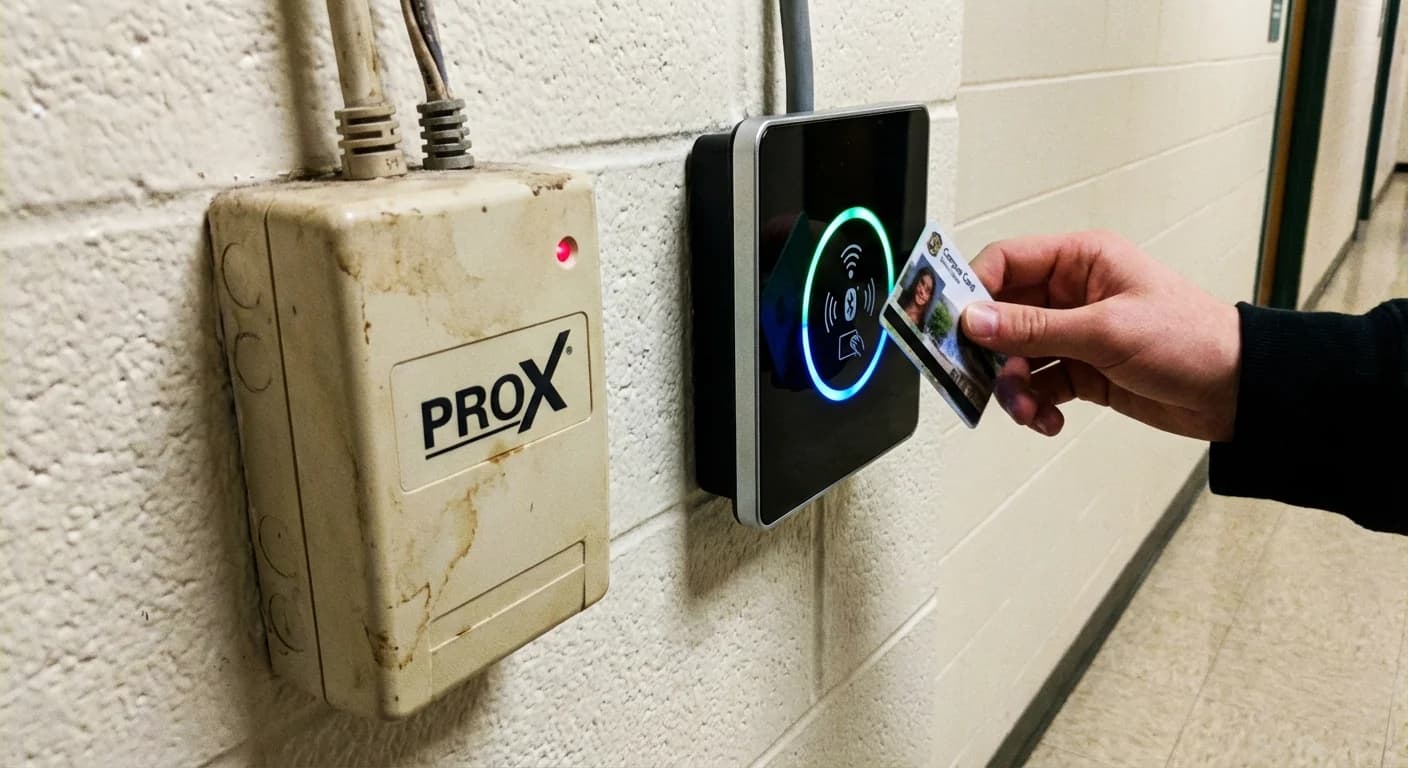
a major access-control vendor's enterprise HF credentials platform was the dominant campus card technology in North America throughout the 2000s and 2010s. Operating at 13.56 MHz with a proprietary protocol, enterprise HF credentials cards offered a significant security improvement over the 125 kHz proximity cards they replaced.

Why enterprise HF credentials Is Being Retired

The original enterprise HF credentials system uses a proprietary encryption scheme that was publicly compromised in 2010. Researchers demonstrated that enterprise HF credentials cards could be cloned using commercially available equipment, undermining the security premise of the entire platform. A major access-control vendor responded with enterprise HF credentials (Secure Element), which added an additional layer of security, but the fundamental architecture remained proprietary and limited.

enterprise HF credentials cards typically offer only 2KB of memory with limited application segmentation. The proprietary protocol means universities are locked into a major access-control vendor's ecosystem for readers, software, and card management — reducing competitive pricing pressure and limiting integration options.

a major access-control vendor has officially positioned enterprise mobile credentials as the successor to enterprise HF credentials and has been encouraging customers to migrate. New enterprise HF credentials-only deployments are rare, though many campuses still operate mixed environments during transition periods.

enterprise mobile credentials: A major access-control vendor's Next-Generation Platform

enterprise mobile credentials (pronounced "SEE-oss") is a major access-control vendor's modern credential platform, designed from the ground up to support both physical cards and mobile credentials. It operates on a proprietary protocol but with significantly improved security compared to legacy enterprise HF credentials.

Security and Mobile Readiness

enterprise mobile credentials uses modern cryptography, mutual authentication, secure messaging, and a major access-control vendor's Secure Identity Object (SIO) data model. It is designed to be form-factor independent and mobile-ready. The exact algorithms, key model, wallet support, and certification scope depend on the enterprise mobile credentials product and deployment, so they should be verified against the selected credential and reader documentation.

The Proprietary Trade-Off

enterprise mobile credentials remains a controlled, licensed ecosystem, but it is not limited exclusively to a major access-control vendor-branded readers. A major access-control vendor supports enterprise mobile credentials across its own reader families and licenses the enterprise mobile credentials applet to qualified third-party device manufacturers. Universities should compare available readers, licensing, key ownership, backend integration, and long-term exit options rather than assuming either complete lock-in or open interoperability.

Head-to-Head Comparison

Security

high-security AES HF EV3, enterprise HF credentials, and enterprise mobile credentials use different security architectures and certification boundaries. lists Common Criteria EAL5+ certification for high-security AES HF EV3 hardware and software, but an assurance level should not be treated as a universal ranking of complete campus systems. Compare the exact certified product and scope, cryptographic configuration, reader-to-controller channel, key custody, backend controls, and threat model.

Cost

Card prices vary with memory, credential format, personalization, material, licensing, volume, and region, so static per-card ranges become unreliable quickly. Compare current written quotes on the same specification and model total cost across readers, secure key infrastructure, software, integration, issuance, support, and migration.

high-security AES HF has a broad multi-manufacturer reader ecosystem. Enterprise mobile credentials is available through a major access-control vendor reader families and qualified licensed integrations. That difference can affect procurement leverage and integration choices, but it does not justify a universal cost multiplier without project-specific quotes.

Mobile Credential Support

Both high-security AES HF and enterprise mobile credentials can participate in mobile credential deployments through different platform architectures. Wallet availability is not a property of the chip alone: it depends on the campus platform, credential service, reader profile, licensing, country, and wallet certification. Verify the complete supported combination before selecting a physical-card migration path.

Migration Paths

Universities running legacy enterprise HF credentials can evaluate migration to enterprise mobile credentials within the licensed a major access-control vendor ecosystem or to a high-security AES HF-based profile supported by multiple reader suppliers. Either path may reuse some readers and require replacement of others. Firmware capability, licensing, secure key storage, controller support, and the installed credential profile must be checked model by model.

Multi-technology cards that combine enterprise HF credentials, enterprise mobile credentials, and high-security AES HF on a single credential are available and commonly used during transition periods. These dual/triple-tech cards allow universities to migrate building by building or system by system without disrupting daily operations.

Which Chip Should Your University Choose?

The choice depends on institutional priorities. Universities seeking a broad multi-vendor reader ecosystem may evaluate high-security AES HF EV3, while institutions with compatible a major access-control vendor infrastructure may find a enterprise mobile credentials migration operationally simpler. Legacy enterprise HF credentials and 125 kHz proximity deployments should be assessed against current cloning, downgrade, key-management, and operational risks, with a documented migration plan where the controls no longer meet the institution's threat model.

At CampusRFID, we manufacture campus cards with any chip technology our clients require — high-security AES HF EV2, high-security AES HF EV3, enterprise mobile credentials, enterprise HF credentials, or multi-technology combinations. Our role is to provide unbiased guidance based on your institution's specific infrastructure, budget, and long-term roadmap.

For a wider procurement view that includes the platform layer (US campus-card platforms, US campus-card platforms, US campus-card platforms) alongside chip selection, see our campus card systems and services buyer's guide.

If you are about to spec a new buy, our high-security access cards (AES-128, diversified keys, anti-clone laminate) and dual credential cards (contact chip + 13.56 MHz contactless in one body, for mixed-fleet migration) are the two pillar SKUs for the scenarios discussed above. The RFID glossary defines every chip and frequency term in plain English.

*Need help choosing the right chip technology for your campus card program? Contact our team for a consultation tailored to your institution's needs.*

Primary sources

Standards, regulations, and first-party technical documentation consulted for this review.

  1. FIPS 197 — Advanced Encryption Standard (AES)National Institute of Standards and Technology

Explore this topic

Product pages selected for the subject covered in this guide.

Share:

Ready to Implement RFID on Your Campus?

Contact us to learn how our RFID solutions can improve campus security and student experience.