Campus Card Security: Encryption, Authentication, and Cloning Prevention
From the broken Crypto-1 cipher on MIFARE Classic to AES-128 encryption on modern DESFire EV3 cards, campus card security has evolved dramatically. This deep dive covers how encryption, mutual authentication, and diversified keys protect your campus — and why legacy systems must be replaced.
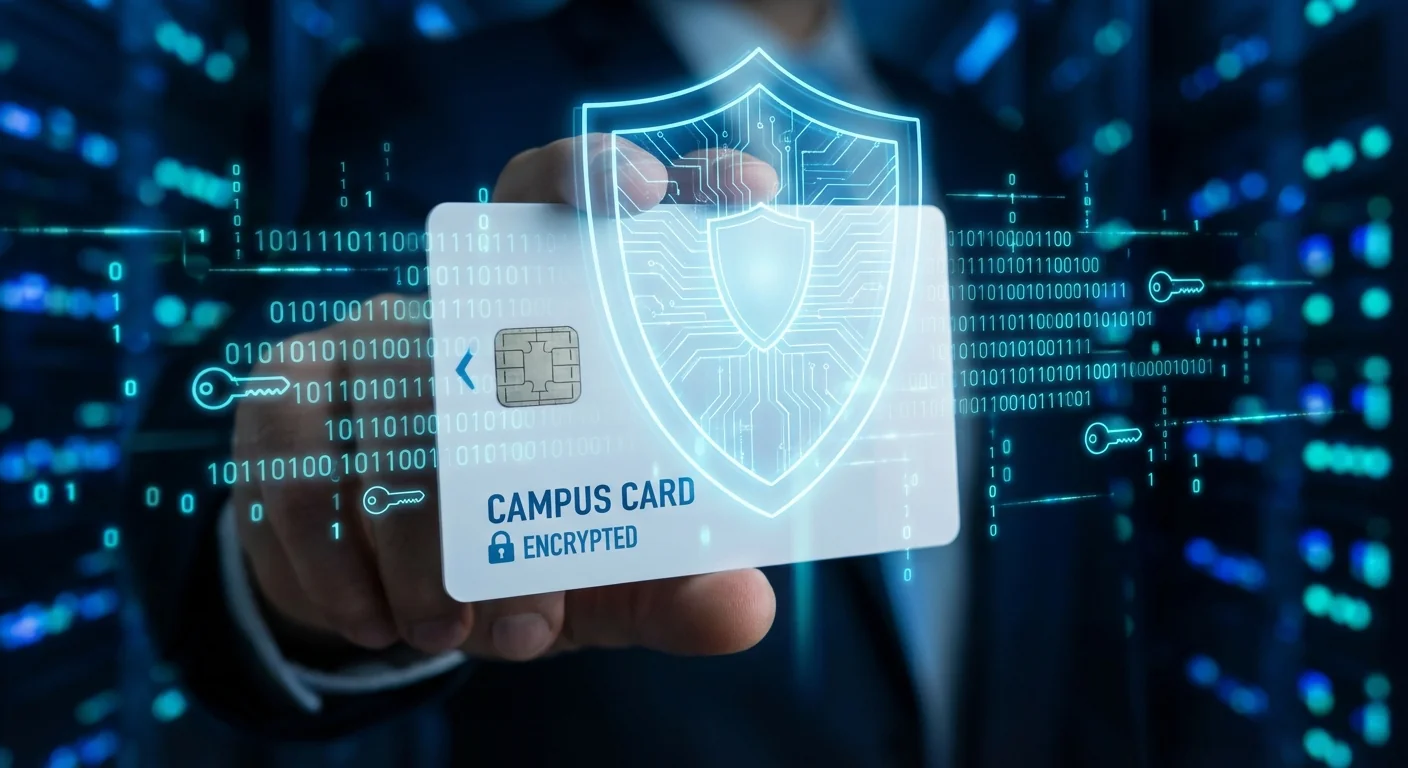
In 2024, a graduate student at a European university demonstrated that he could clone any campus card on the institution's MIFARE Classic-based system using $50 worth of equipment purchased online. Within weeks, the exploit was shared on social media. Unauthorized building access, fraudulent meal plan transactions, and compromised exam security followed before the university could respond. The incident was a wake-up call — but it should never have been a surprise. The MIFARE Classic's Crypto-1 encryption was publicly broken in 2008.
Campus card security is not abstract. A compromised card system means unauthorized people in buildings, stolen meal plan balances, fraudulent library loans, manipulated printing credits, and — in worst cases — physical safety risks. Understanding the cryptographic technologies that protect (or fail to protect) campus cards is essential for every university IT and security professional.
The Cryptographic Landscape of Campus Cards
125 kHz Proximity Cards: Zero Security
The oldest technology still found on some campuses is the 125 kHz proximity card (HID Prox, EM4100). These cards broadcast a static, unencrypted ID number to any reader within range. There is no authentication, no encryption, and no protection against cloning. A device costing under $20 can read and duplicate a proximity card in seconds, from several feet away, without the cardholder's knowledge.
If your campus still uses 125 kHz proximity cards for any access control function, the situation is urgent. These cards offer the same security as an unlocked door — the appearance of control with none of the substance.
MIFARE Classic: Broken Encryption (Crypto-1)
MIFARE Classic cards (operating at 13.56 MHz, ISO 14443A) were a massive improvement over proximity cards when introduced. They use the Crypto-1 stream cipher for authentication between card and reader. Unfortunately, Crypto-1 was reverse-engineered in 2008 by researchers at Radboud University Nijmegen. The attack was subsequently refined to the point where cloning a MIFARE Classic card takes under a minute with readily available hardware.
Despite this, MIFARE Classic remains in use at a surprising number of institutions. The cards are cheap, the infrastructure is established, and migration requires effort and budget. But the risk is real and well-documented: anyone with basic technical knowledge and inexpensive equipment can clone these cards.
MIFARE DESFire EV2/EV3: Modern Security
MIFARE DESFire EV2 and EV3 represent the current security standard for campus cards. These chips implement AES-128 encryption (Advanced Encryption Standard with 128-bit keys) — the same encryption standard used by government agencies for classified information.
**Mutual authentication** is the critical advancement. When a DESFire EV3 card approaches a reader, both the card and the reader must prove their identity to each other before any data exchange occurs. The card proves it holds the correct cryptographic key, and the reader proves the same. This prevents both card cloning (a fake card can't authenticate) and rogue readers (a fake reader can't extract card data).
**Diversified keys** add another security layer. Rather than using the same key for every card, the system derives a unique key for each card based on its serial number and a master key. If one card's key is somehow compromised, it cannot be used to attack any other card in the system.
**Transaction MAC** provides cryptographic proof that a specific transaction occurred between a specific card and a specific reader at a specific time. This is particularly important for cashless payment applications where transaction disputes may arise.
DESFire EV3's **Secure Dynamic Messaging (SDM)** enables secure data exchange with NFC smartphones without requiring a dedicated app — supporting use cases like digital identity verification where a student taps their card on a phone to share authenticated credentials.
HID SEOS: Proprietary Modern Security
HID's SEOS platform implements AES-128/256 encryption within a proprietary framework. The security architecture is robust, using layered encryption and the Secure Identity Object (SIO) model. SEOS credentials are resistant to cloning and support mutual authentication. The trade-off is vendor lock-in — SEOS security operates within HID's closed ecosystem.
Real-World Campus Card Attacks
Understanding the threat landscape requires looking at actual incidents:
Migration Priority Framework
If your university is evaluating card security, here's a priority framework:
Critical — Migrate Immediately
Monitor — Plan Migration Within 2-3 Years
Current — Meets Modern Security Standards
Practical Security Recommendations
Beyond chip selection, campus card security requires attention to the broader system:
At CampusRFID, we manufacture campus cards using the latest chip technologies — DESFire EV2, DESFire EV3, SEOS, and multi-technology combinations for migration scenarios. Every card we produce is programmed with your institution's specific key configuration and security parameters.
*Concerned about your campus card security? Contact our team for a security assessment and migration planning consultation.*
Ready to Implement RFID on Your Campus?
Contact us to learn how our RFID solutions can improve campus security and student experience.
Related Articles
Unified Access Control: How Universities Are Merging RFID, Lockdowns, and Mobile Credentials
Campus security is undergoing its most significant transformation in a decade. As universities face an evolving threat landscape—from ideological violence to sophisticated cyber intrusions—security leaders are abandoning patchwork solutions in favor of unified access control platforms that bring...
Emergency Lockdown Systems: How RFID Technology Saves Lives on Campus in 2026
When seconds count during a campus emergency, traditional lock-and-key systems become dangerous liabilities. Security officers cannot physically reach every door in time. Students fumble with manual locks while panic spreads. In 2026, universities are adopting RFID-powered emergency lockdown...